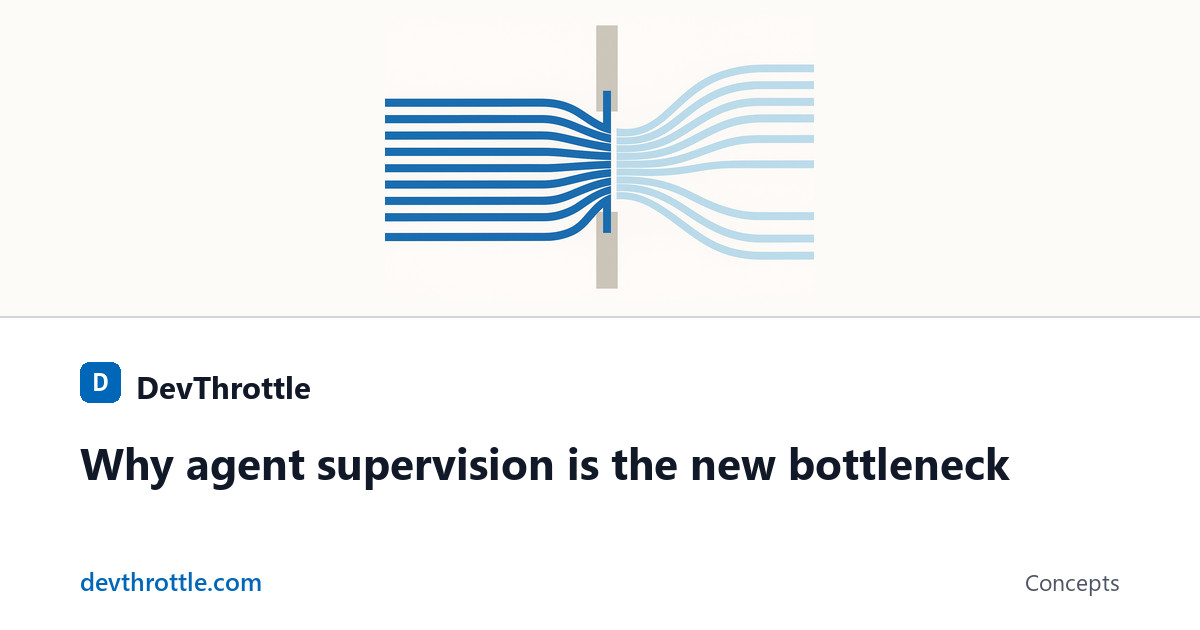
For most of the history of software, the bottleneck was typing. Not literally the keystrokes - the whole act of turning intent into working code: writing it, testing it, fixing it. Every tool we celebrated, from IDEs to autocomplete, was a typing accelerator. AI coding agents ended that era quietly, and almost nobody has updated their tooling to match. The bottleneck is no longer producing code. It is watching the things that produce it.
The claim, stated plainly
A modern coding agent - Claude Code, Codex, and their peers - works unattended for minutes at a time. During those minutes it does not need you. Which means the limit on your output is no longer how fast you can write code, or even how fast one agent can. It is how many agents you can supervise at once without dropping one. That number - call it your span of control - is the new constraint on a software developer's productivity. And almost all of our tools still optimize the old constraint.
How I ran into it
I have spent 38 years in technology, most of it as a consultant, a lot of it managing teams of developers. When I started using Claude Code seriously, the first phase felt like every productivity story you have read: one agent, big tasks, remarkable output. Then I started a second session while the first one worked. Then a third. On a good day now I have six or more running.
And somewhere between the second and the sixth, my job changed underneath me. I was not writing code anymore. I was assigning work, reviewing results, answering questions, and unblocking stalled sessions - the exact job I used to do as a manager of human developers. Except my "team" lived in a stack of terminal windows with no status view, no notifications, and no way to tell a working agent from one that had been waiting on a question for forty minutes. The agents were never the problem. The watching was.
The failure mode nobody prices in
Here is the arithmetic that convinced me this is a real bottleneck and not a workflow quirk. An agent that hits a question stops completely until you answer. If you notice in thirty seconds, parallelism works. If you notice in forty minutes, that session ran at a fraction of its potential - and you paid full attention-cost anyway, because you were cycling through windows all day checking on it. Multiply that by four or six sessions and the silent-stall tax quietly dominates everything the agents gained you. Supervision is not overhead on the work. At fleet scale, it is the work.
Typing tools, watching tools
Once you see the shift, you can sort every developer tool into two piles. Editors, autocomplete, IDE copilots: typing tools. Status boards, attention routing, remote check-in: watching tools. The industry has spent three decades perfecting the first pile and about three years pretending a terminal multiplexer is the second. It is not. tmux can show you six panes; it cannot tell you which of the six needs a human right now. That gap - between displaying agents and supervising them - is where the productivity of this whole era either compounds or leaks away.
So I built the watching part
DevThrottle is my answer, and I built it for my own fleet first. It puts every agent on one place with three states - Working, Waiting on you, Done - so the stalled session is the loudest thing on the screen. A background service keeps agents running when no window is open. And because supervision should not chain you to a desk, you can check in and answer from any browser or your phone, by voice if you want. It is open source, it runs the CLIs you already use, and it runs on Windows - because I work on Windows, and nearly everything in this space assumed I did not.
The proof I care about most: DevThrottle is built with DevThrottle. The agents that wrote much of this product run inside it, supervised from its own Director, every day. When I say the bottleneck moved from typing to watching, I am not theorizing - I am describing my Tuesday.
What to do with this
If you run one agent, enjoy it - you do not have this problem yet. The moment you start a second session, you do, whether you have named it or not. Watch where your attention goes for a day: if you are cycling through windows asking "is anyone stuck?", the bottleneck has already moved, and it is you. Create an account, download the Windows app, and you will have your first supervised agent running in about ten minutes.
Run your agents from one control room
DevThrottle orchestrates command-line coding agents across your machines.
Create free account