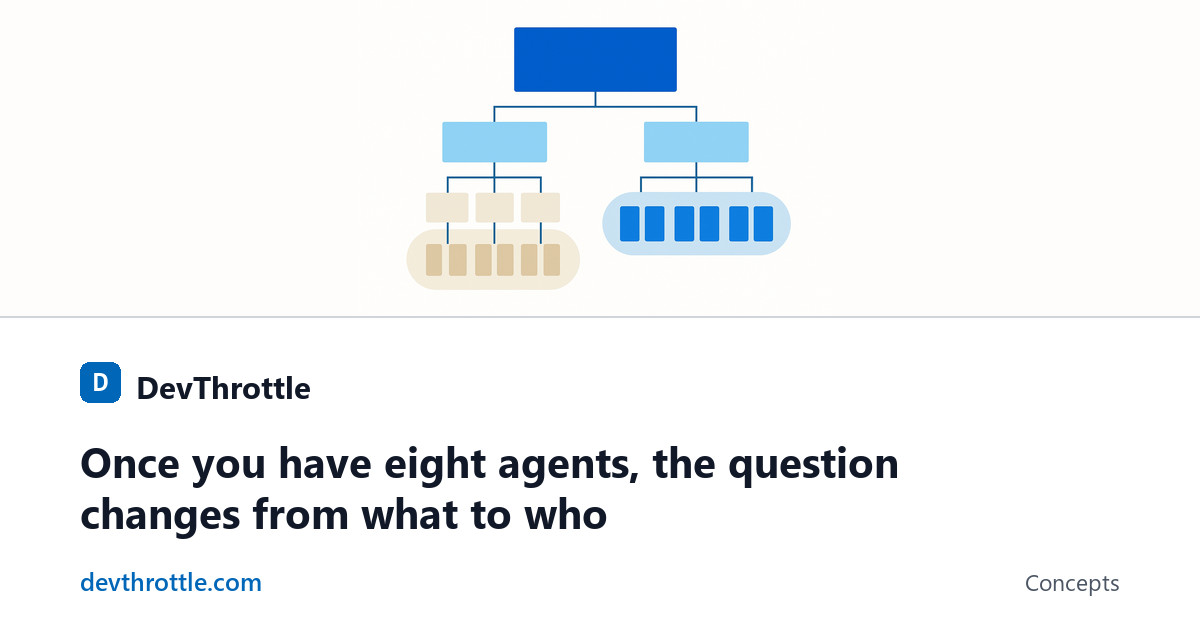
Two coding agents you can hold in your head. Four is a stretch. By eight, the question you are asking when you look at the screen has changed shape. It is no longer "what is each of these doing" - you cannot read eight terminals - it is "who is in charge of what, and which of these belong together."
That is a management question, and a list of sessions cannot answer it. So DevThrottle records two things about every session beyond its name: the role it is playing, and the mission it belongs to.
Roles
A role describes a session's place in a piece of work. It is not a different kind of agent - the same coding agent can be a Worker on one task and a Manager on another. Four roles are recorded today:
- Standalone. The default, and where most of a casual fleet lives. A solo session facing you, not wired to anything else.
- Architect. The session that settles the design and directs the others. This is the one role DevThrottle can never work out for you - nothing about how sessions are wired says which one is the planner - so an Architect exists only because you said so.
- Manager. The session driving a phase of the work and supervising the sessions doing it.
- Worker. Heads-down on one piece. A session started by another session becomes a Worker by default, controlled by the session that started it.
The value of this is not the labels. It is that you can sweep a busy Director once and see the shape of the work: which sessions are solo, which one plans, which supervise, which are producing. That takes a second. Reading eight terminals does not.
Missions
A mission is a name that related sessions share. It answers the other half of the question - not who is in charge, but which of these forty sessions are the same piece of work.
The moves are the ones you would expect and they are the ones that matter in practice: move any session in or out of any mission, rename a mission when the work turns out to be about something slightly different, end one when it is finished, and bring one back if it turns out it was not. Work does not stay in the boxes you drew for it on the first morning, so the boxes have to move.
Why record it rather than remember it
Three reasons, in ascending order of how much they matter.
The small one is the screen. A role is a badge; you read the fleet faster.
The middle one is your phone. The mission and the role travel with the session, so when a card comes up on a phone screen asking you something, you know which piece of work you are being pulled into before you read the question.
The one that earns it is tomorrow. A fleet you left running on Friday is an anonymous list on Monday. Names, roles and missions are the only thing that survives the weekend - not because you wrote a document, but because you declared the structure while you had it in your head, at the moment it cost nothing.
The reference is session roles and missions; the walkthrough is the roles tutorial.
Run your agents from one control room
DevThrottle orchestrates command-line coding agents across your machines.
Create account