Governance report (coming soon)
3 min read
The governance report will be one private report you open each week to see how you actually run your fleet of coding agents: where your time went, what you shipped, how effective it was, and whether every agent stayed inside your rules. It reads what your Cockpit already records, plus the agents' own histories.
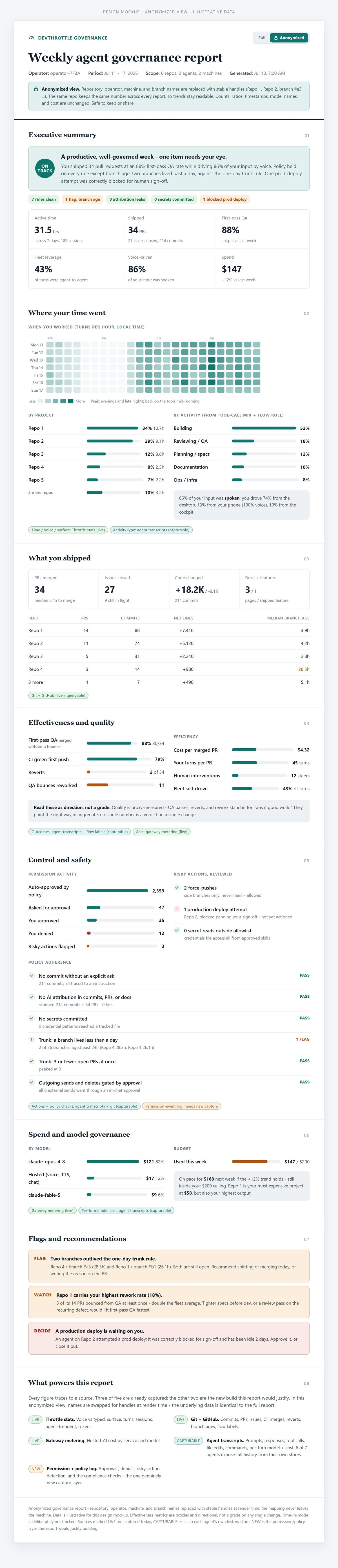
What it will show
- Where your time went. By project and by kind of work - building, reviewing, planning, docs, ops - plus how much you drove by voice versus keyboard, and from your phone, desktop, or the Cockpit.
- When you did it. A day-by-hour heatmap of your week, so your real working rhythm is plain to see.
- What you shipped. Pull requests merged, issues closed, commits, and code changed - per repository.
- How effective it was. Honest, directional signals - first-pass review rate, rework, reverts, cost per merged change, and how much of the work the fleet drove on its own. Proxies, not a grade on any single change.
- Whether it stayed in the rules. Approvals and denials, risky actions surfaced for review, and a plain checklist against your own policies - no commit without an explicit ask, no secrets committed, branches that live less than a day, and so on.
Keep it private, or share it safely
The report will come in two forms from the same data. The fullreport is for you alone. The anonymized report - the one pictured above - replaces repository, operator, and branch names with stable handles like Repo 1, Repo 2, and operator-7F3A, so the same repository keeps the same number across every week. Every count, ratio, timestamp, and dollar figure is unchanged; only the names are hidden. That version is safe to keep off your machine or share with someone else.
Where the data will come from
Most of what the report needs already exists. Your throttle stats (voice versus typed, surfaces, sessions), your Git and GitHub activity (commits, pull requests, reviews), and your hosted-AI usage are all recorded today. The agents' own session histories add what you asked, what they did, and what each turn cost. The one genuinely new piece is a record of approvals, denials, and policy checks - the part that powers the control-and-safety section.
Where to go next
For what your account has spent to the cent today, see Usage. For the Director this report will live beside, see the Cockpit.